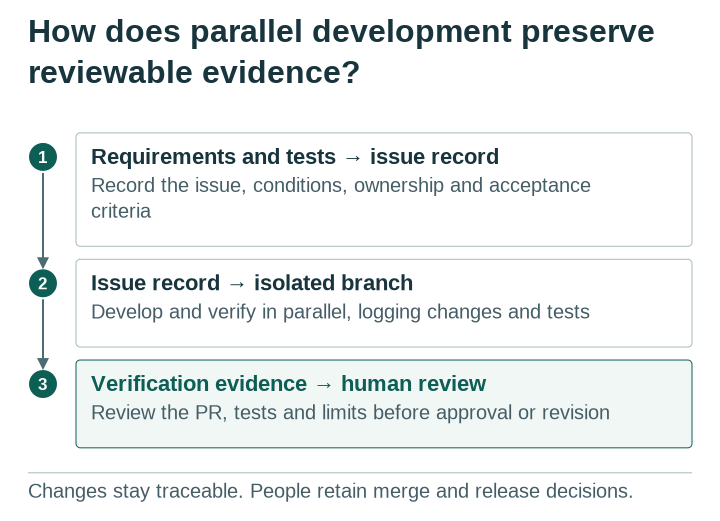
Connect project and issue records with daily regression across all functions, parallel repairs and verification, and human review and release decisions.
Git worktree
systemd timer
Bitbucket
AI agents
Role
Established requirements, tool rules, persistent context and validation workflows. Coordinated AI agents developing, repairing and verifying in isolated branches, while handling product and domain judgments and reviewing merges and releases with reviewers.
Results and status
Established traceable requirements, decisions, branches, tests and delivery records for daily regression, parallel repairs and verification, and new feature development.
Record period
2026 workflow records
Context and objectives
Faster AI implementation requires traceable control of incorrect assumptions, unreliable evidence and branches awaiting review.
Changes stay traceable. People retain merge and release decisions. (Enlarge image)
System architecture and workflow
Architecture overview
Inputs
Requirements, code changes, tests and issues from daily regression.
Process
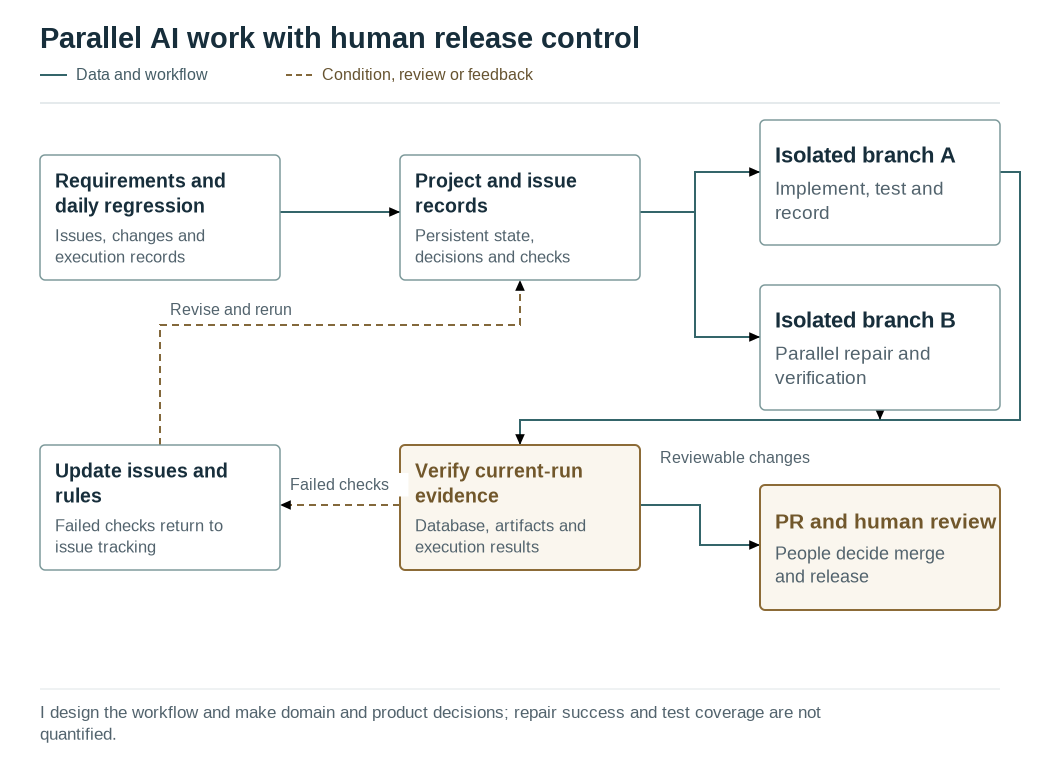
Projects and issues retain status and decisions; AI agents implement, repair and verify in parallel on isolated branches.
Outputs
Reviewable changes, verification records and PRs. Results inform rules; people decide merges and releases.
Workflow diagram
I design the workflow and make domain and product decisions; repair success and test coverage are not quantified. (Enlarge image)
Key design decisions
Make parallel AI tasks traceable and transferable
ChallengeConcurrent development and repairs cannot rely on chat context and scattered branches to preserve decisions, verification and review status.
Approach and tradeoffsI established project and issue records separating persistent status, daily changes and verification evidence. I built the environment and handover contract connecting daily regression across all functions, branch implementation and testing, AI coordination, domain judgment and human review.
ResultNew features and maintenance share a continuous workflow with recorded requirements, branches, daily regression, parallel repairs and verification, and human release decisions.
Verification must be able to overturn a reported success
ChallengeAutomated work may produce outputs or success flags without actual execution or submission. Complete-looking records can still be false verification.
Approach and tradeoffsI defined verification and closure criteria requiring checks against the database, actual artifacts and current-run execution logs. Execution and review are separated; failed checks return to issue tracking, testing and rule revisions.
ResultClosure depends on current execution and original evidence. Stale outputs, unsaved files and blocked submissions are identified and fed back into issue and validation rules.
More technical detail
Confirming that fixes reached the demo build
I reviewed fixes before release by checking issue records, code merge status, and the demo build. This showed which fixes were pending merge, ready for retest, or already accepted.
Results and validation scope
Deliverables
Established traceable requirements, decisions, branches, tests and delivery records for daily regression, parallel repairs and verification, and new feature development.
Validation and limits
Validation checks actual execution and artifacts. Test coverage, repair success and efficiency gains are unmeasured; shared services require separate control.
Established a traceable project space connecting customer needs, open decisions, issues, verification and delivery. Also defined and supervised intern research topics.