I analyze vibration and partial discharge using field waveforms and equipment operating data. I check signal quality, interpret abnormal patterns, and explain which conclusions can inform maintenance decisions.
I lead development and own delivery for two Harbor AI 2.0 products: industrial monitoring and end-of-line quality inspection. I lead algorithm design and experiments and integrate the methods into software and field workflows.
Industrial signal analysisUse vibration trends, spectra, and phase-resolved partial discharge (PRPD) patterns to interpret signals, and test data and model assumptions for remaining useful life (RUL) estimates.
Product and system designDefine data, workflow, and interface requirements for two distinct products: equipment monitoring and factory quality inspection.
AI collaboration and deliveryUse traceable requirements, decisions, and test records to coordinate development, with regression tests and human review to check release quality.
Connect equipment data, abnormal events and analysis reports to support routine monitoring and maintenance decisions.
Role
Lead developer responsible for the product, domain design, analysis scheduling, event analysis, and reporting integration.
Led vibration and partial discharge methods and experiments, checked event-window coverage, and validated data assumptions for RUL estimates.
Results
Operators can trace alerts back to the event window, see how much data was available, review the analysis, and access diagnostic reports. Version 2.0 operates independently of 1.0.
Support configurable factory inspection for different machine models, from measurement plans and references to NG/OK decisions and feature-deviation analysis.
Role
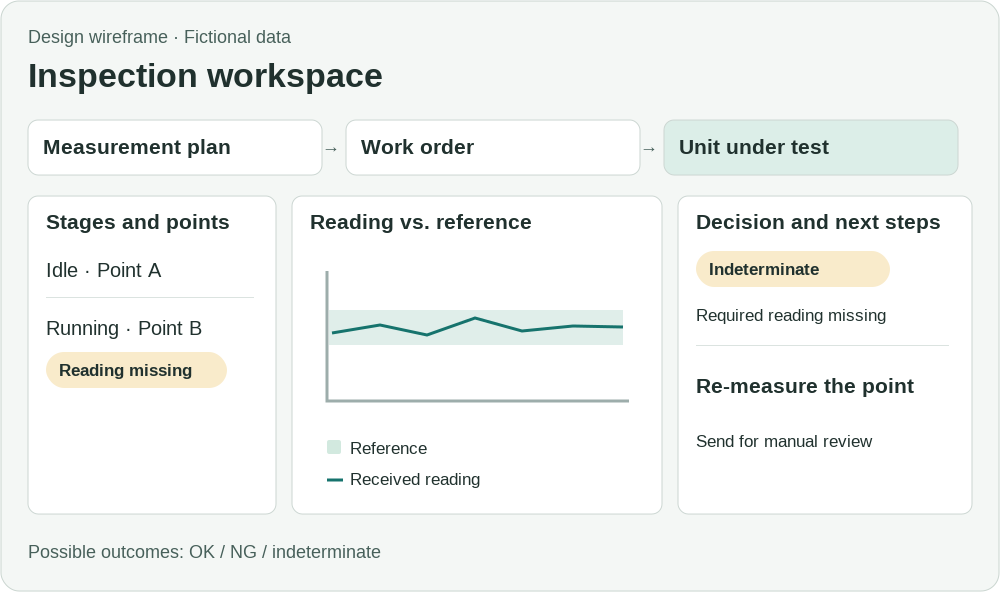
Lead developer responsible for the inspection product. Translated model-specific measurement needs into plan, work-order, and unit workflows with testable operator requirements.
Led quality decision algorithms and experiments. Defined stage- and point-specific references for conforming units and used thresholds and feature deviations to support pass/fail decisions.
Results
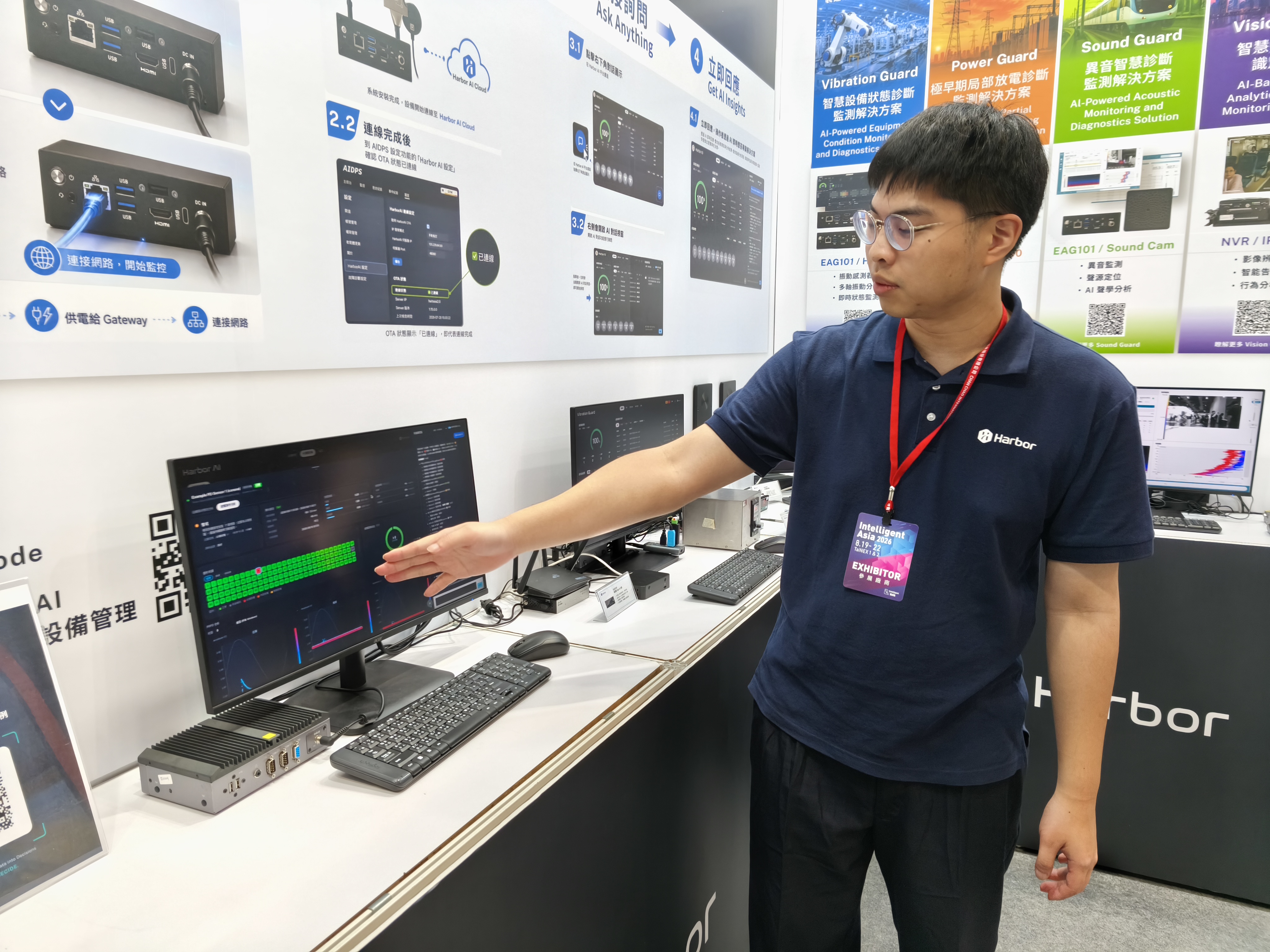
I demonstrated the system and trained operators on site. The software workflow passed Phase 2 acceptance. Phase 3 is testing whether the measurements can reliably distinguish passing from failing units.
Design wireframe · Fictional data. The plan, work order, and unit form a hierarchy. Operators can check measurement points, compare references, and handle missing readings in one workspace. (click to enlarge)
Shares the Harbor AI 2.0 technical foundation with the monitoring platform, while serving different operational and delivery needs.
Investigate chromatin-interaction prediction from DNA sequences using a multiscale CNN, testing the contribution of different sequence scales.
Role
Lead research design, modeling, data pipelines, ablation and cross-dataset evaluation; adapt part of the preprocessing from ChINN.
Results
Completed the master's thesis, research code, and explainability analysis, documenting limits in generalization across cell types and the effect of shifts in interaction anchors.
Reconnect person records after occlusion or tracking interruptions using person re-identification.
Role
Own person ReID: integrate FastReID, multiple samples and dual-threshold matching with task queues and record updates.
Results
The team demonstrated occlusion, crossing and reappearance scenarios and won first place in the capstone competition; real-time performance remained limited.
Let helpers prepare application information while keeping content approval and final submission with the applicant.
Role
Own the topic, use cases, specifications and final presentation; define authorization, data permissions and acceptance criteria.
Results
The team reached the final and demonstrated a simulated single-use authorization flow for one case and one helper; official identity verification and government integration were not completed.
Passenger flow estimation needs representations of time-varying transport relationships.
Research contribution:Handled method ideation, data processing, modeling and experiments for a coauthored study of dynamic embeddings and passenger flow estimation.
Financial sentiment analysis needs both vocabulary and article-level context.
Research contribution:Handled literature, problem definition, data processing, modeling and experiments with coauthors. Investors provided sentiment annotations.