How do you recognize the same person after a track breaks? I integrated appearance matching into the team's tracking system.
FastReID
Cosine similarity
Person ReID
Role
Responsible for person ReID, combining FastReID appearance features, multiple samples and two-threshold decisions with queued matching and tracking-record updates.
Results and status
The team built the multi-camera system and tested occlusion, passing encounters and re-entry scenarios, winning first place in Soochow University's 2020 capstone competition. Real-time operation remained limited.
Record period
2020 capstone records
Context and objectives
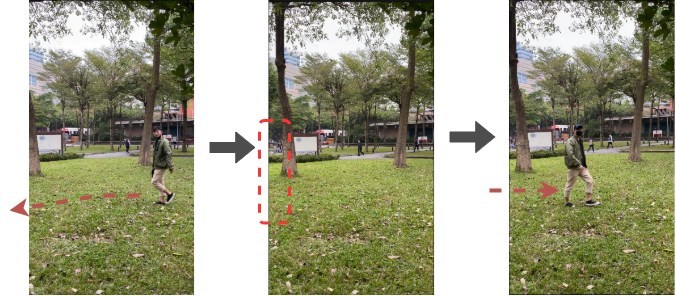
Turning, occlusion or leaving and re-entering a camera view can change a person's tracking ID, while faces may not be visible. The team combined tracking, face recognition and ReID to reconnect separate track segments.
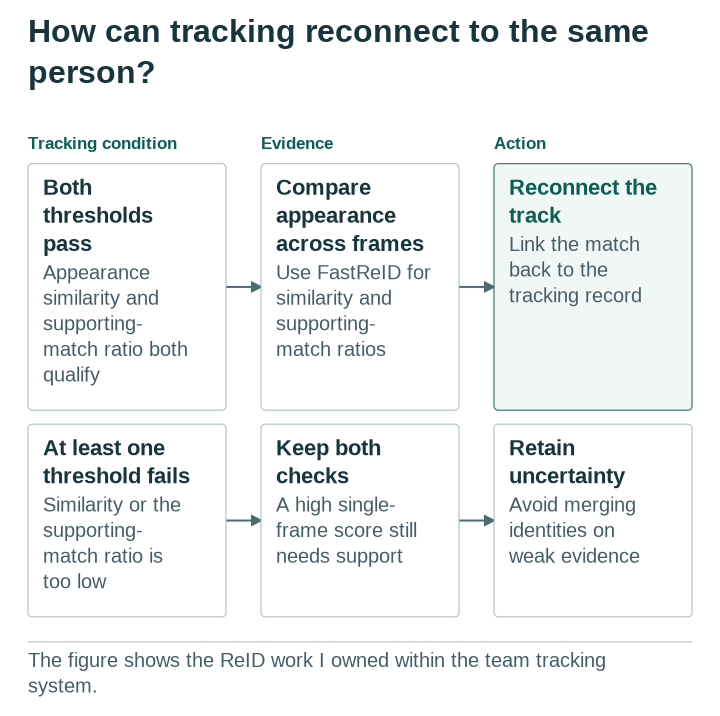
The figure shows the ReID work I owned within the team tracking system. (Enlarge image)Original team test: leaving and reappearing. I handled ReID matching and workflow integration. (Enlarge image)
System architecture and workflow
Architecture overview
Inputs
Multi-camera track segments and images of people across times and angles.
Process
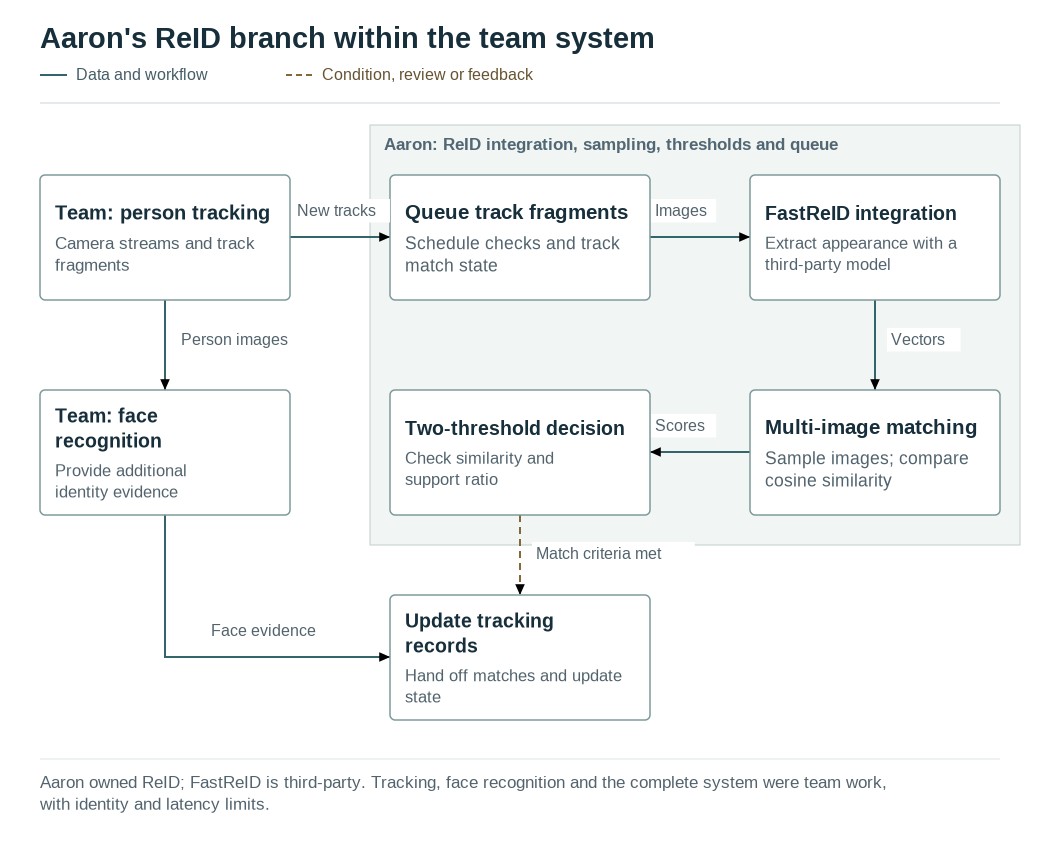
I integrated FastReID features, comparing similarity and support across multiple samples and connecting the results to tracking records through a queue.
Outputs
Team multi-camera tracking and identification demonstration; first place in the capstone competition.
Workflow diagram
Aaron owned ReID; FastReID is third-party. Tracking, face recognition and the complete system were team work, with identity and latency limits. (Enlarge image)
Key design decisions
Use agreement across multiple images
ChallengeOcclusion, turning and viewpoint changes make a single appearance comparison insufficient to link identities.
Approach and tradeoffsI designed track sampling, cross-image matching and dual thresholds for similarity and support. FastReID features and cosine similarity produce matches organized by the two conditions.
ResultTurned appearance matching into an adjustable, traceable decision process without claiming to eliminate occlusion or mistaken identity.
Connect ReID results back to tracking
ChallengeContinuous tracks require clear rules for when to match, when matching finishes and which record to update.
Approach and tradeoffsI managed pending track records with queues and states, connecting first and second checks, timeouts, completion and update states, and database handover.
ResultIntegrated ReID into the team workflow. The overall team delivered scenario demonstrations and won first place; real-time performance remained limited.
Results and validation scope
Deliverables
The team built the multi-camera system and tested occlusion, passing encounters and re-entry scenarios, winning first place in Soochow University's 2020 capstone competition. Real-time operation remained limited.
Validation and limits
ReID uses third-party FastReID; the team integrated the overall system. Occlusion, mistaken matches and real-time performance remain limitations.
Competition scale
Soochow University capstone selection; a public team or participant total for that year was not found.
Team result
The team won first place in the capstone competition.