Study financial article sentiment using sentiment terms and a Hierarchical Attention Network.
Sentiment lexicon
Hierarchical Attention Network
Sentiment Attention Network
Role
Handled literature, problem definition, data processing, modeling and experiments with coauthors. Investors provided sentiment annotations.
Results and status
Extended a student research project into a formal TCSE 2020 publication.
Record period
Published in 2020
Context and objectives
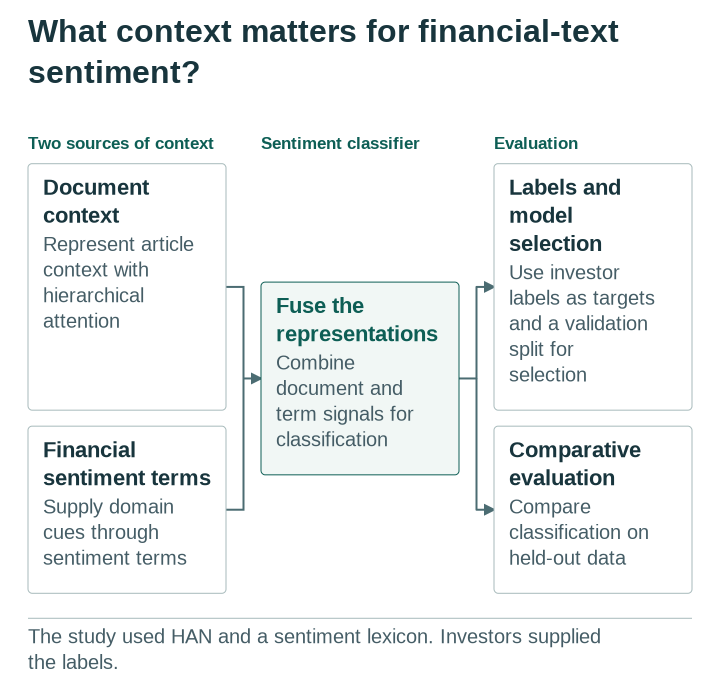
Financial sentiment analysis needs both vocabulary and article-level context.
The study used HAN and a sentiment lexicon. Investors supplied the labels. (Enlarge image)
System architecture and workflow
Architecture overview
Inputs
Financial articles, sentiment terms and sentiment targets annotated by multiple people.
Process
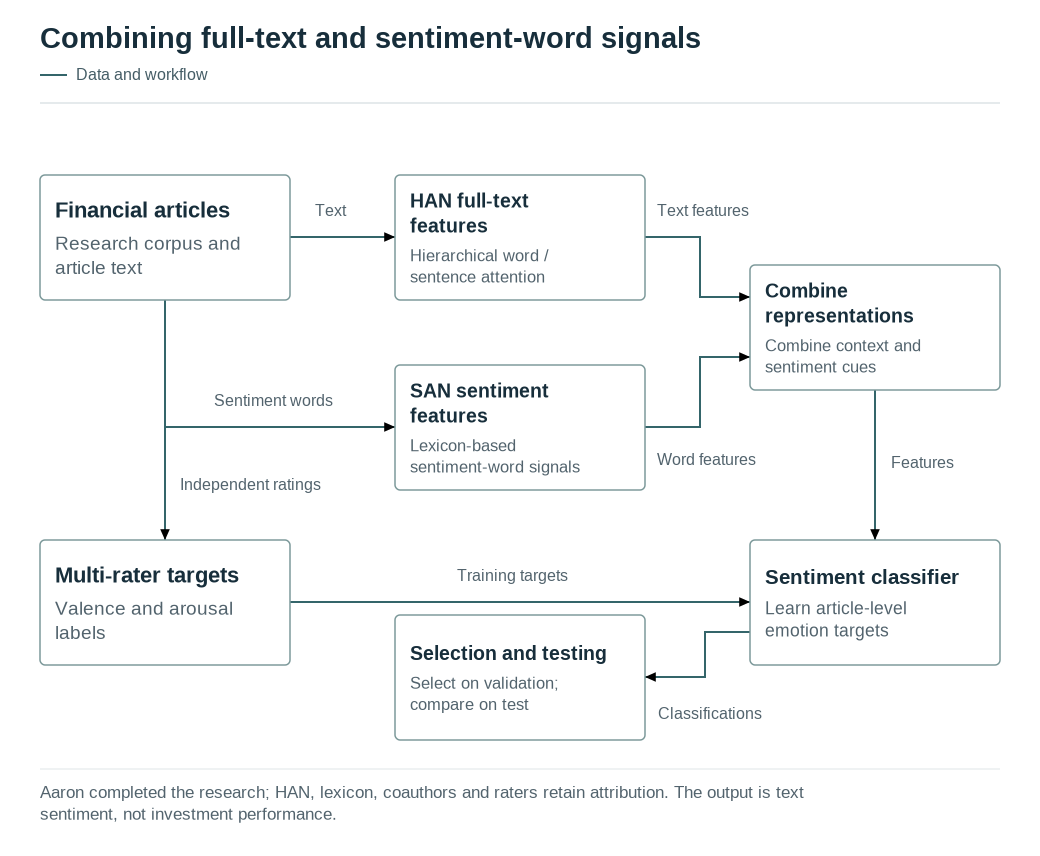
Combine full-text hierarchical attention with sentiment-term representations; select models on validation data and compare on a test set.
Outputs
Sentiment-classification research extending a student project into a TCSE paper.
Workflow diagram
Aaron completed the research; HAN, lexicon, coauthors and raters retain attribution. The output is text sentiment, not investment performance. (Enlarge image)
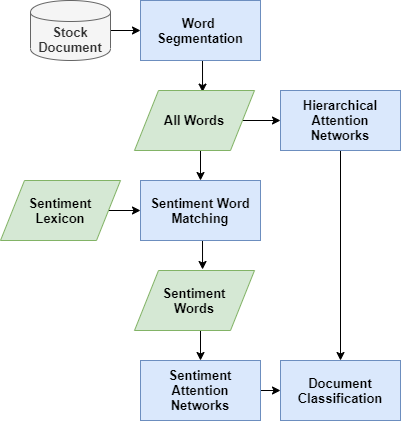
Original research figure
Original joint-research figure: sentiment terms and hierarchical attention. (Enlarge image)
Key design decisions
Define a learnable sentiment task in my first research project
ChallengePositive and negative news alone cannot describe a reader's arousal. My first research project required a clear question and annotation definition.
Approach and tradeoffsI completed the literature, data and model research, separating polarity and arousal. Five investors annotated independently; scores were averaged after removing extremes and handling disagreement. Annotator and coauthor contributions remain explicit.
ResultDeveloped a student project into a trainable classification task and a TCSE publication, building experience across problem definition, annotation, modeling and experiments.
When model changes stall, revisit data and comparisons
ChallengeRepeated model changes did not improve early results. Architecture changes alone could not distinguish data, parameter and representation limits.
Approach and tradeoffsI expanded the data and compared parameters and variants, combining HAN full-text and SAN sentiment-term representations. Validation data guided selection and a test set supported comparison. Exploration was less systematic at this stage; later work refined ablation and parameter strategies.
ResultRetained models, data and controlled comparisons, informing later research improvements. Sentiment classification is not evidence of investment returns.
Results and validation scope
Deliverables
Extended a student research project into a formal TCSE 2020 publication.
Validation and limits
The output is article sentiment classification, using HAN and a sentiment lexicon, with annotator and coauthor contributions retained.