Study dynamic embeddings for passenger flow estimation.
Dynamic embeddings
BERT
GMAN
Role
Handled method ideation, data processing, modeling and experiments for a coauthored study of dynamic embeddings and passenger flow estimation.
Results and status
Produced an IIAI AAI 2021 publication and Competitive Paper Award.
Record period
Published in 2021
Context and objectives
Passenger flow estimation needs representations of time-varying transport relationships.
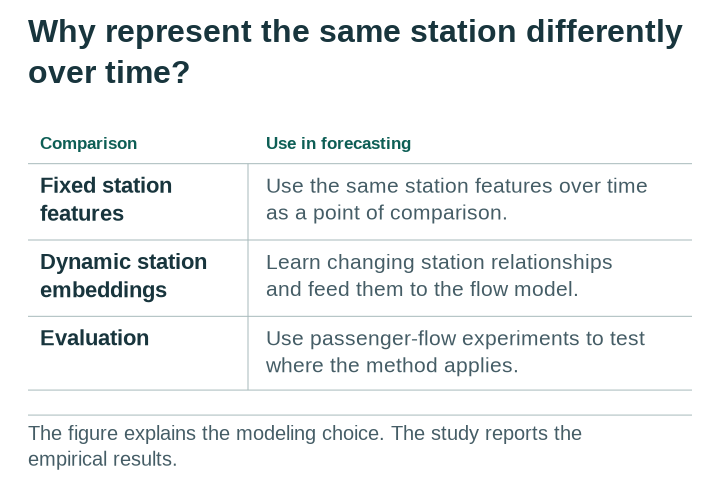
The figure explains the modeling choice. The study reports the empirical results. (Enlarge image)
System architecture and workflow
Architecture overview
Inputs
Station distances, historical flows and changing travel contexts.
Process
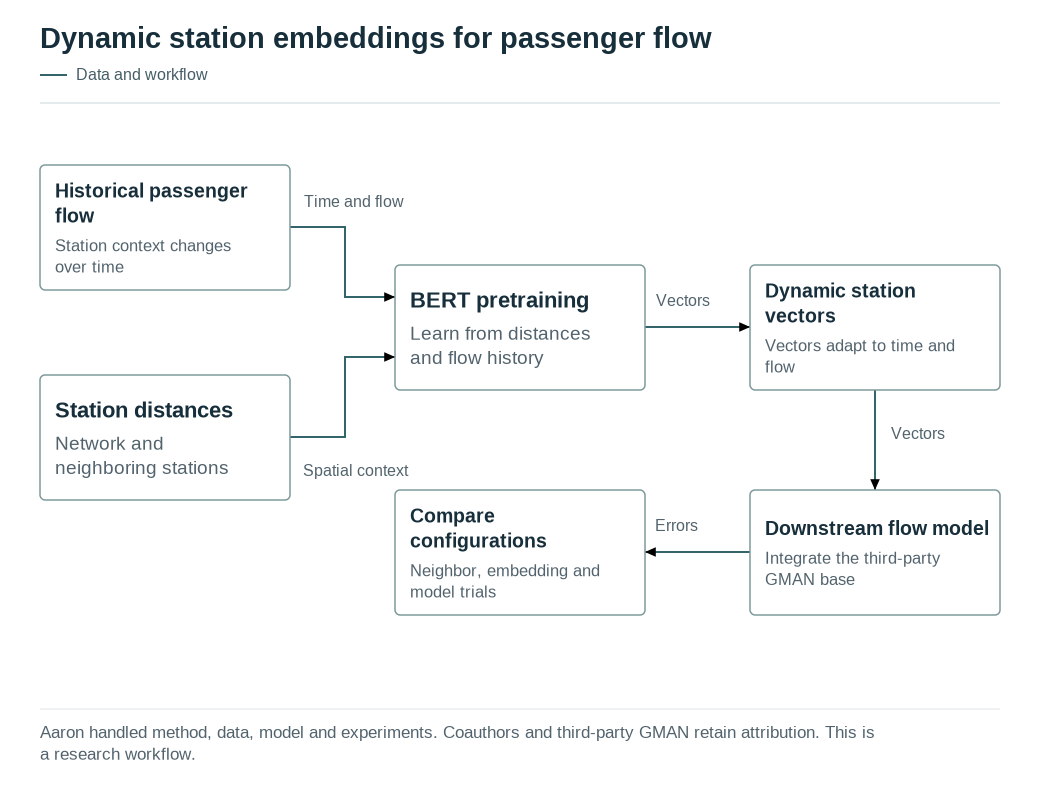
Pretrain dynamic representations of station relationships across time, then supply a downstream flow-estimation model.
Outputs
Method comparisons, models and experiments leading to an IIAI AAI paper and a team paper award.
Workflow diagram
Aaron handled method, data, model and experiments. Coauthors and third-party GMAN retain attribution. This is a research workflow. (Enlarge image)
Original research figure
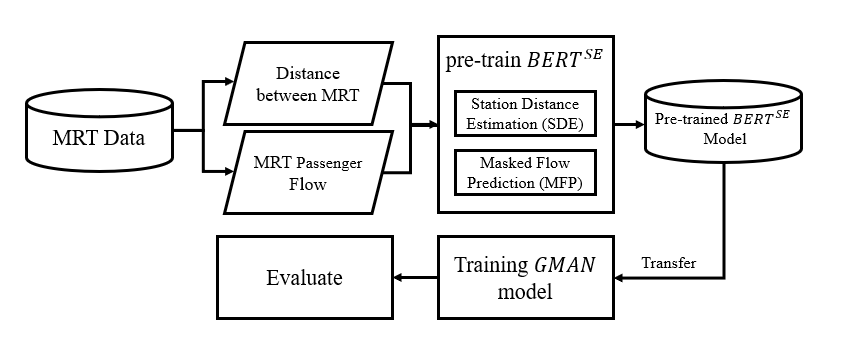
Original joint-research figure: BERT dynamic embeddings and passenger flow estimation. (Enlarge image)
Key design decisions
One station should not always have one fixed representation
ChallengeA fixed station vector cannot express different peak and off-peak conditions.
Approach and tradeoffsI handled method ideation, data processing, modeling and experiments. The joint research combined BERT pretraining with station distance and historical flow to generate time- and flow-dependent station representations for downstream estimation.
ResultTurned the idea into models and comparison experiments, producing a coauthored IIAI AAI 2021 paper and Competitive Paper Award.
Compare many experiments with limited training resources
ChallengeNeighborhood, distance and route conditions required separate comparisons, while limited GPUs and repeated preprocessing constrained experiments.
Approach and tradeoffsI ran model and parameter experiments, preserving configurations and results for different neighborhoods and representations. Across this and later research, I developed shell-based parallel runs, separate logs and models, H5 preprocessing caches and parameter exploration, used to different degrees in each project.
ResultRetained experiment histories for neighborhood and representation comparisons and result aggregation. These practices continued in later research, with project-specific use.
Results and validation scope
Deliverables
Produced an IIAI AAI 2021 publication and Competitive Paper Award.
Validation and limits
Models and comparative experiments validate the method; the paper is coauthored.