Dynamic transport networks and flow prediction (2024)
Study dynamic transport representations and metro passenger flow prediction.
Dynamic transport-network representations
BERT
GRU
MLAN
Role
Provided code and technical support as a coauthor; the model methods and experiments were team research.
Results and status
Produced a formal Knowledge-Based Systems journal article in 2024.
Record period
Published in a journal in 2024
Context and objectives
Metro flow forecasting needs model representations of dynamic transport relationships.
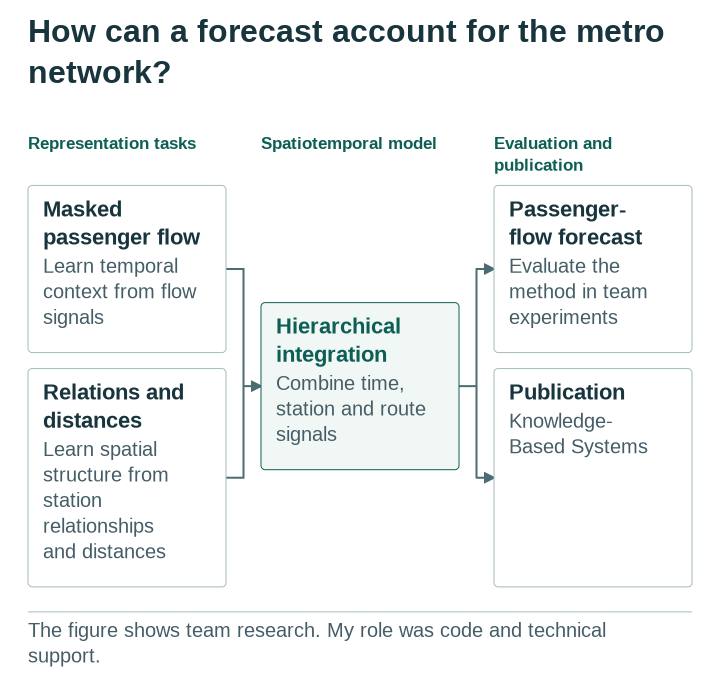
The figure shows team research. My role was code and technical support. (Enlarge image)
System architecture and workflow
Architecture overview
Inputs
Metro network structure, flows and temporal variation.
Process
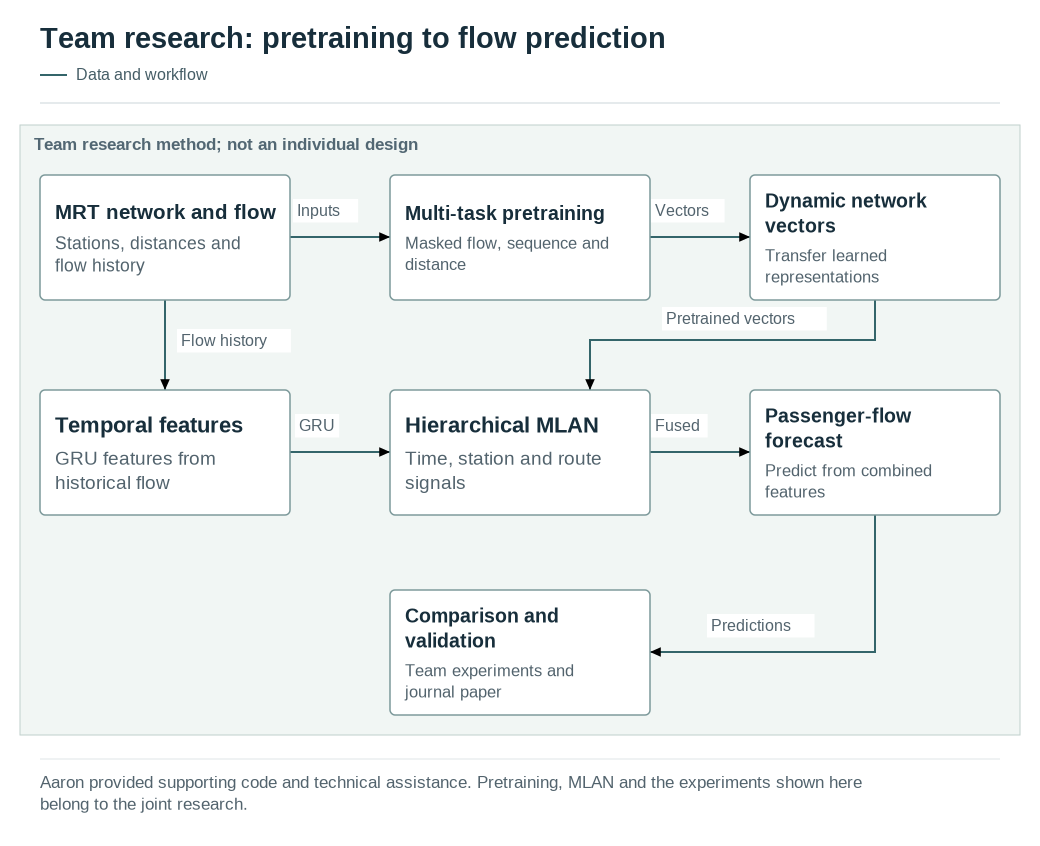
The joint study learns representations through masked-flow, station-relation and distance tasks, then hierarchically combines time, station and route signals.
Outputs
Transport forecasting methods and a Knowledge-Based Systems article.
Workflow diagram
Aaron provided supporting code and technical assistance. Pretraining, MLAN and the experiments shown here belong to the joint research. (Enlarge image)
Original research figure
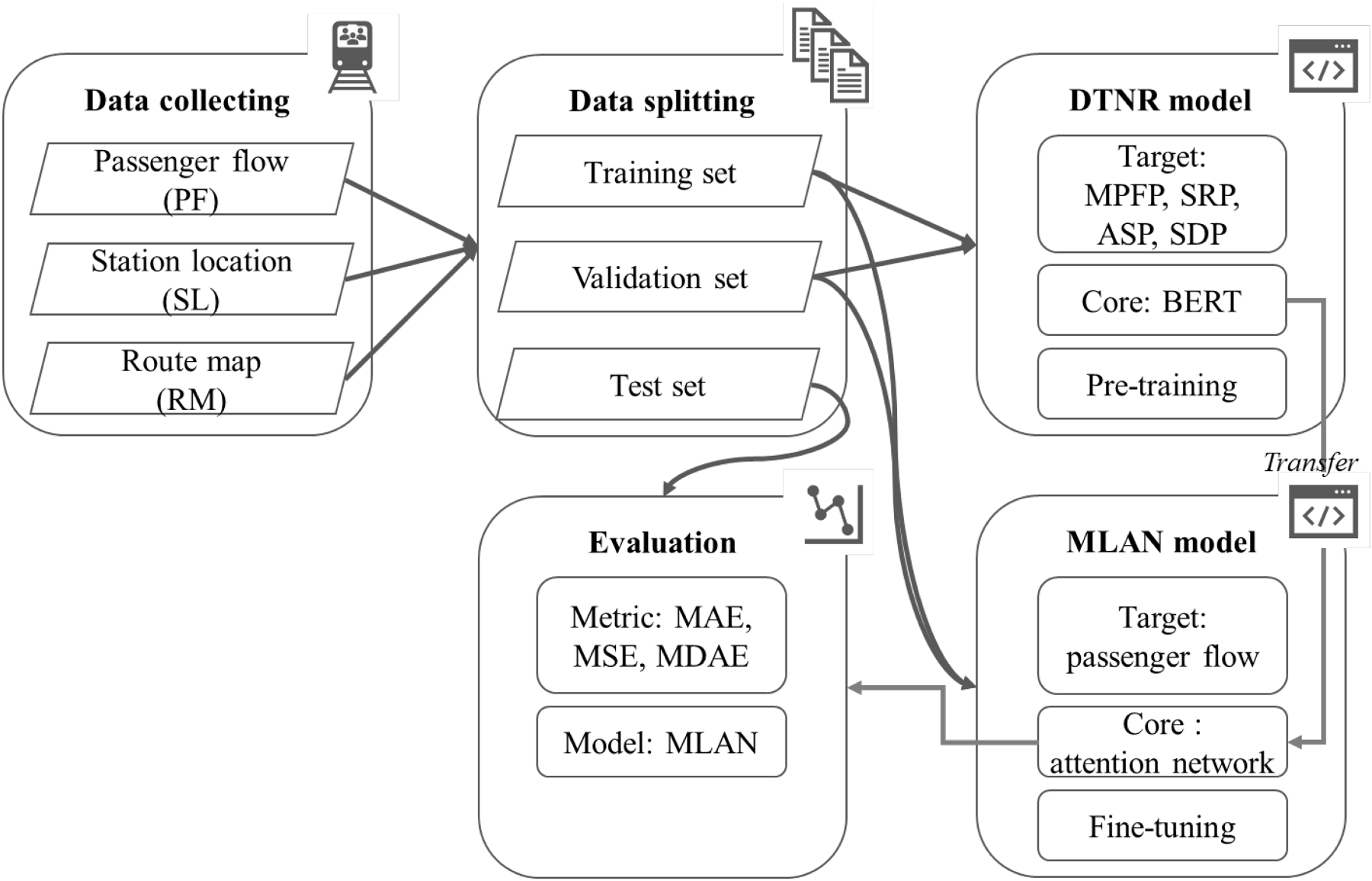
Original joint-research figure: transport representations and flow prediction. (Enlarge image)
Approach and tradeoffsThe joint study used multiple pretraining tasks for station and spatial relationships, combining masked flow, station sequences and distance before transferring representations to a forecasting model.
ResultThe team completed dynamic transport methods and comparative experiments, producing a Knowledge-Based Systems article.
Combine time, nearby stations and routes hierarchically
ChallengeFlattening nearby stations can lose shared-route and transfer-direction structure.
Approach and tradeoffsThe joint study used MLAN to hierarchically integrate time, station and route signals, combining pretrained representations with GRU features and comparative validation.
ResultThe team developed comparable transport-network forecasting methods. My scope was code and technical support.
Results and validation scope
Deliverables
Produced a formal Knowledge-Based Systems journal article in 2024.
Validation and limits
The page explains team methods and experiments. My responsibility was code and technical support.