The chat interface needs clear waiting and tool feedback, without exposing internal documents or raw citation markers as answers.
SSE
RAG
Semantic cache
Regression testing
Role
Defined requirements, interaction design, and the audience for knowledge content. Tested the product and used the findings to refine responses and UI.
Results and status
Checked waiting indicators, tool status, and source citations in the interface. The knowledge base uses audience tags to select which sources to show, and retrieval and caching were tested. Some scenarios with real users still need validation.
Record period
2026 development and validation records
Context and objectives
The chat interface needs clear waiting and tool feedback, without exposing internal documents or raw citation markers as answers.
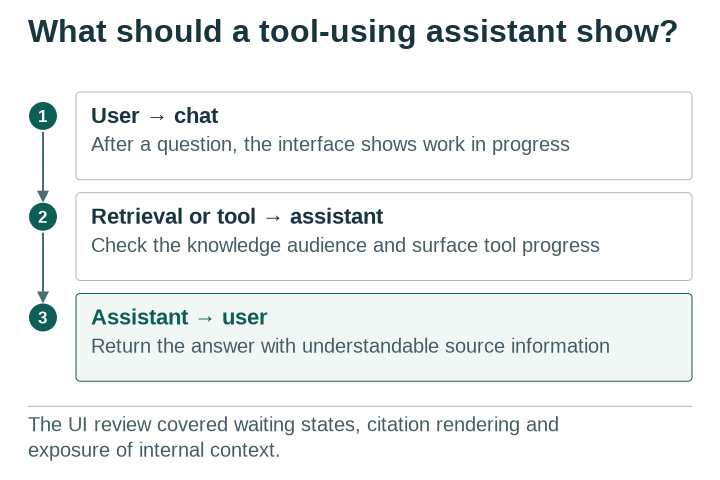
The UI review covered waiting states, citation rendering and exposure of internal context. (Enlarge image)
System architecture and workflow
Architecture overview
Inputs
User questions, tool execution states and audience-appropriate knowledge.
Process
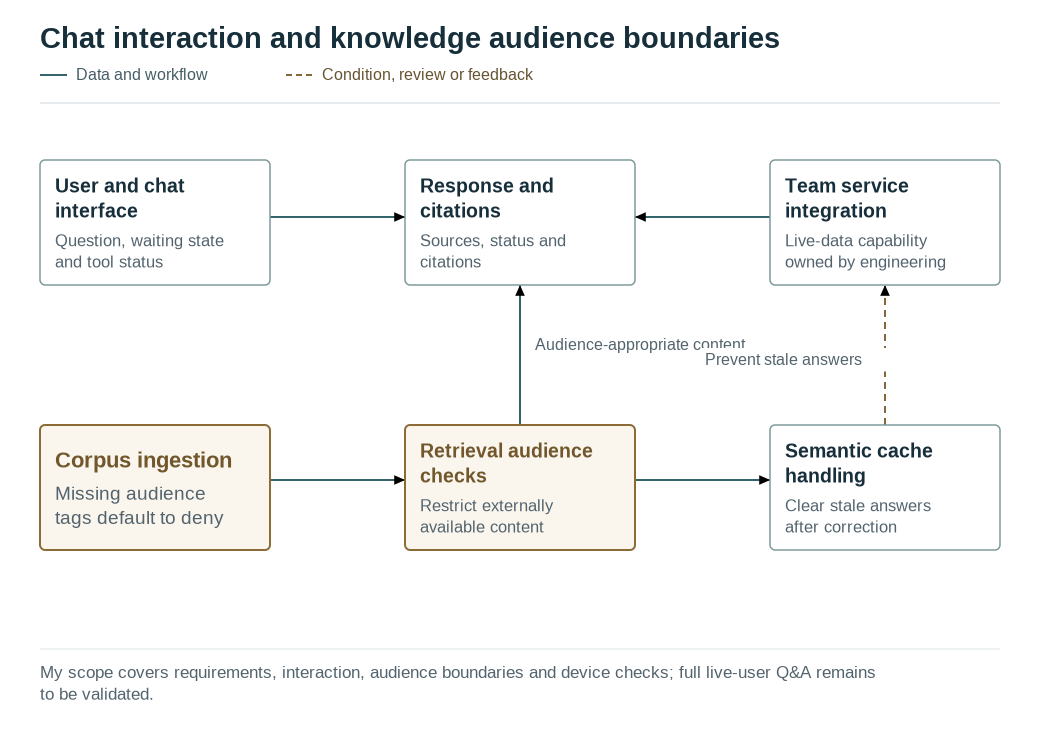
The frontend presents waiting states and tool sources. Ingestion, retrieval and semantic caching jointly enforce audience boundaries.
Outputs
Understandable processing feedback and citations without leaking internal context into answers.
Workflow diagram
My scope covers requirements, interaction, audience boundaries and device checks; full live-user Q&A remains to be validated. (Enlarge image)
Interface and interaction
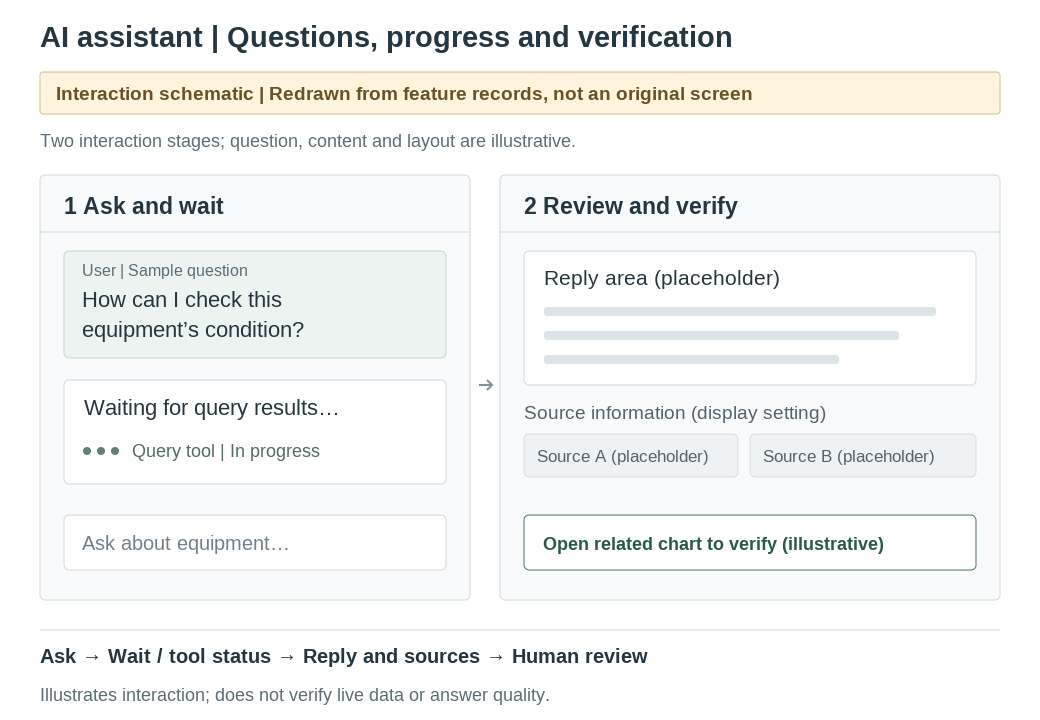
The schematic explains questions, progress, tool feedback and returning to source data for verification. Original internal conversations are not published.
Interaction schematic redrawn from feature records, not an original screen; no real equipment data or model answer is included. (Enlarge image)
1 / 1
Key design decisions
Explain what the assistant is doing while users wait
ChallengeWithout concrete feedback during tool processing, users cannot distinguish waiting, retrieval and response states.
Approach and tradeoffsI added requirements and helped choose interactions and conduct device walkthroughs. I coordinated agents to connect waiting text, tool sources and visibility controls to actual processing states, including pushed status and citation handling.
ResultWaiting feedback, tool information and citations are integrated into the platform, with records of my device walkthrough.
Trace leaked internal context back to knowledge sources
ChallengeAnswers to product questions exposed internal development modules. Hiding citations alone would not change the retrieval corpus.
Approach and tradeoffsI helped define external audience and content boundaries and coordinated AI agents to reorganize the corpus. Content without audience tags defaults to exclusion from the external knowledge base. The fix included reimporting content and clearing semantic caches to prevent stale answers.
ResultThe external corpus and audience safeguards are integrated and checked for retrieval, citations, leakage and failure fallback. Some scenarios with real users still need validation.
Results and validation scope
Deliverables
Checked waiting indicators, tool status, and source citations in the interface. The knowledge base uses audience tags to select which sources to show, and retrieval and caching were tested. Some scenarios with real users still need validation.
Validation and limits
Interface, retrieval and cache behavior have been checked. Full user Q&A and live-data services continue to be validated by the responsible team members.
An industrial AI platform for equipment and sensor management, live monitoring and alerts, vibration and partial discharge analysis, remaining useful life (RUL) estimation, diagnostic reporting, and operator feedback.