Designed multi-scale convolutional models for 3D chromatin interaction prediction from DNA, with ablation, cross-dataset evaluation and interpretability.
CNN
Multi-scale feature extraction
XAI
ChINN
Role
Independently led the research question, model architecture, data pipeline, evaluation and thesis writing; some preprocessing was adapted from ChINN.
Results and status
Completed the thesis, research code and configurations supporting ablation, cross-dataset evaluation and model interpretation.
Record period
2024 master's thesis
Context and objectives
Convert DNA signals at different scales into testable 3D chromatin interaction predictions.
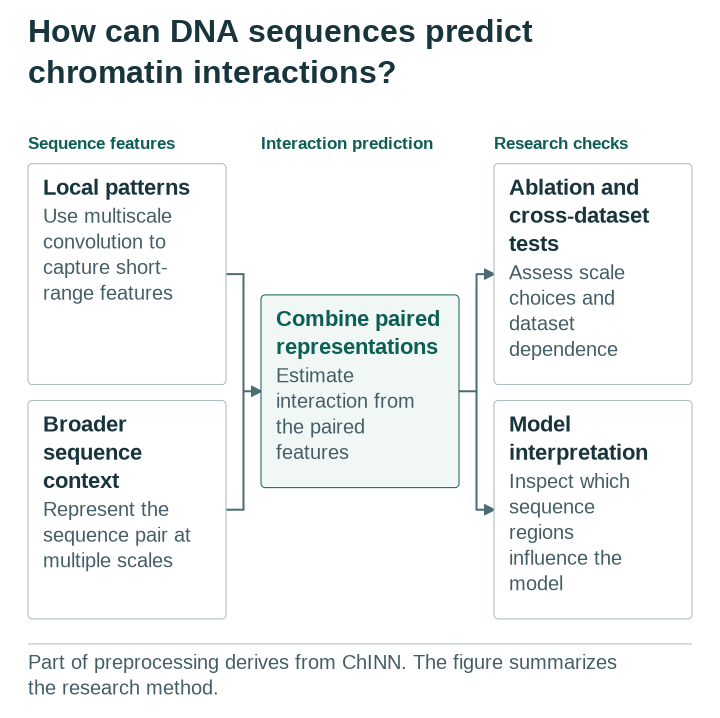
Research question: can a multi-scale design use local sequence signals of different lengths together for prediction?
Validation path: keep data settings consistent, compare models and ablations, then examine cross-dataset behavior and explainability.
Part of preprocessing derives from ChINN. The figure summarizes the research method. (Enlarge image)
System architecture and workflow
Architecture overview
Inputs
DNA sequence pairs and chromatin interaction / CTCF loop data.
Process
Use multi-scale CNNs to inspect signals across ranges, checking them through ablation, cross-dataset evaluation and interpretability.
Outputs
Master's thesis, research code and traceable experiment configurations.
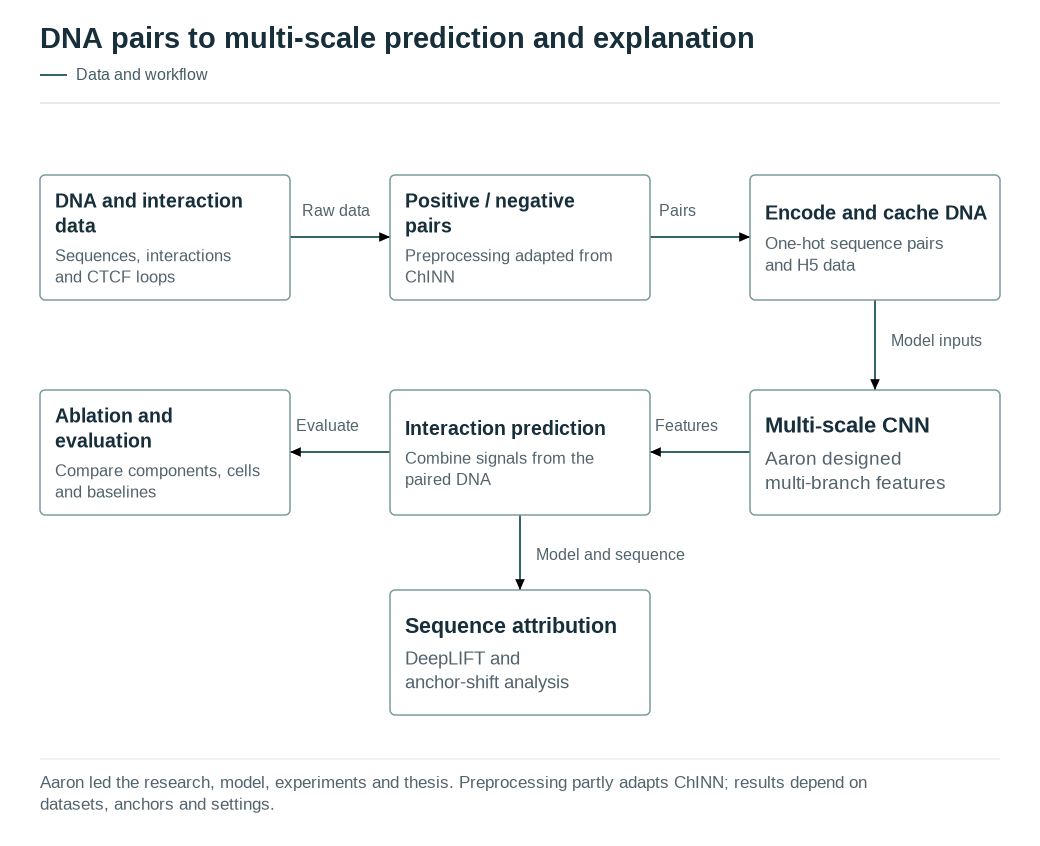
Workflow diagram
Aaron led the research, model, experiments and thesis. Preprocessing partly adapts ChINN; results depend on datasets, anchors and settings. (Enlarge image)
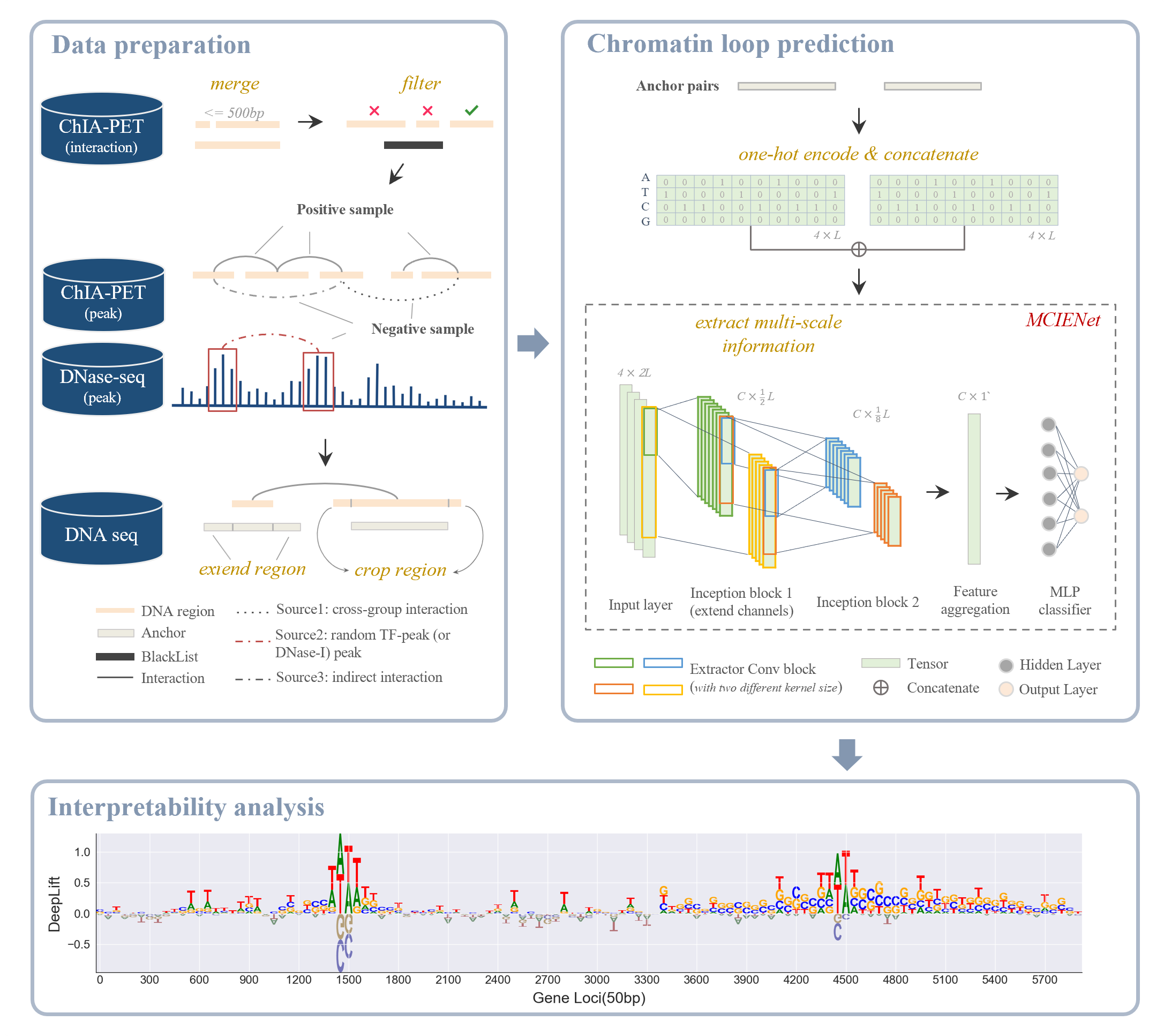
Original research figure
Original research workflow: data preparation, MCIENet and interpretability; some preprocessing is based on ChINN. (Enlarge image)
Key design decisions
Capture DNA signals at different scales
ChallengePredicting chromatin interactions from sequence alone requires local motifs and longer-range signals.
Approach and tradeoffsI designed Inception-based multi-scale feature extraction with ablation, implementing parallel convolutions and aggregation while preserving kernel, channel and pooling configurations. Building on earlier research, I organized H5 preprocessing caches, separate logs and model files, and parameter exploration for more systematic thesis comparisons.
ResultCompleted the multi-scale model, comparison workflow and thesis, allowing architectural choices to be evaluated separately.
Do not assume large pretrained models suit every dataset
ChallengeDNA-structure prediction across cell types may need different representations; pretraining scale does not establish suitability.
Approach and tradeoffsI compared cell datasets and a DNABERT2 baseline on GM12878 and HeLaS3, preserving data, model settings and baseline workflows to examine applicability.
ResultThe thesis records weaker DNABERT2-512 performance on HeLaS3 under these settings. This does not generalize to all pretrained models.
Look beyond scores to sequence sensitivity
ChallengePrediction scores do not explain whether shifting an anchor destabilizes the method.
Approach and tradeoffsI used DeepLIFT to inspect sequence contributions and limitations of long sequences and anchor positions, comparing salient regions and documenting center-shift observations.
ResultThe thesis identifies stability limitations of anchor-based methods under center shifts and retains the interpretation boundary.
More technical detail
How multi-scale convolutions form features
Inputs are a pair of DNA sequences and an interaction label. Parallel convolution branches extract local signals at different lengths. Two Inception feature-extraction layers and configurable aggregation form predictive features; ablation examines the effect of each design.
Reproducible ablation and its limits
Configurations compare a length-9 branch with parallel length-3/5/7/9 branches. Both retain 1×1 and pooling branches, with 100 total channels and the same learning rate, training limit and data settings. Parameter counts still require separate control; configuration alone does not prove a scale effect or superiority.
Data splits and third-party methods
Comparison workflows share train/dev/test splits and retain entry points for BaseCNN, MCIENet, DeepLIFT and format conversion. Shared splits do not establish non-overlapping genomic regions or cross-cell generalization. Some preprocessing builds on ChINN, and comparison entry points do not imply all baselines were completed.
Results and validation scope
Deliverables
Completed the thesis, research code and configurations supporting ablation, cross-dataset evaluation and model interpretation.
Validation and limits
Some preprocessing is adapted from ChINN; interpret model performance and generalization within the actual data and settings.