Progressed from diagnostic content and LangGraph validation to report services, platform jobs and downloads, separating testable numerical decisions from generated narrative.
LangChain
LangGraph
DOCX
Role
Led diagnostic methods, report structure, and quality checks. Developed the analysis prototype and integrated the report service, job dispatch, and downloads.
Results and status
Delivered customer analysis reports, built a reusable analysis workflow, and integrated the reporting service. Multi-equipment processing and regeneration of selected report sections were tested in a prototype. The full on-site workflow and formal acceptance remain to be confirmed.
Record period
2026 reporting development records
Context and objectives
Turn diagnostic reports into schedulable, rerunnable and downloadable services while retaining numerical evidence and missing-data handling.
Customer analysis: check data, operating states and diagnostics in notebooks before delivering reports.
Reusable workflows: use skills to standardize analysis, quality checks and internal-to-customer report conversion.
Prototype validation: use LangGraph to examine multiple devices, regeneration of selected report sections and missing-data fallback.
Platform integration: complete report services, platform jobs, DOCX and frontend downloads; verify the full on-site workflow separately.
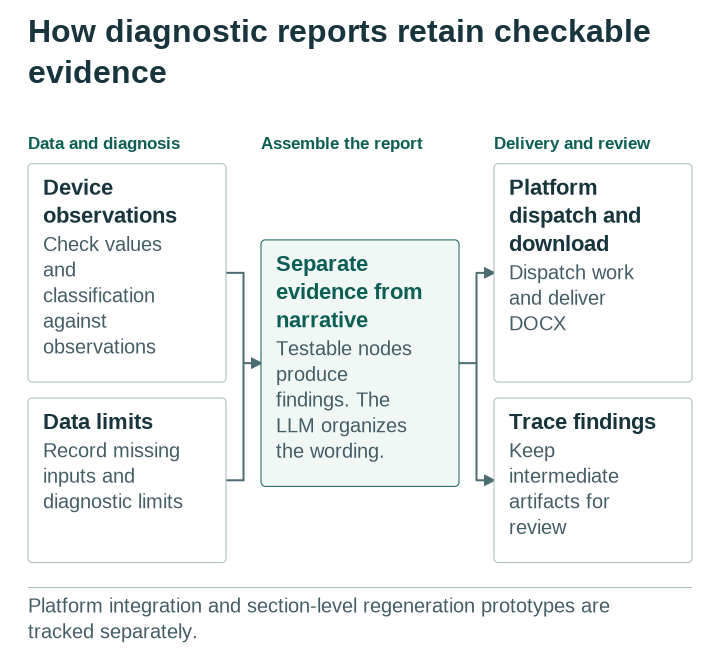
Platform integration and section-level regeneration prototypes are tracked separately. (Enlarge image)
System architecture and workflow
Architecture overview
Inputs
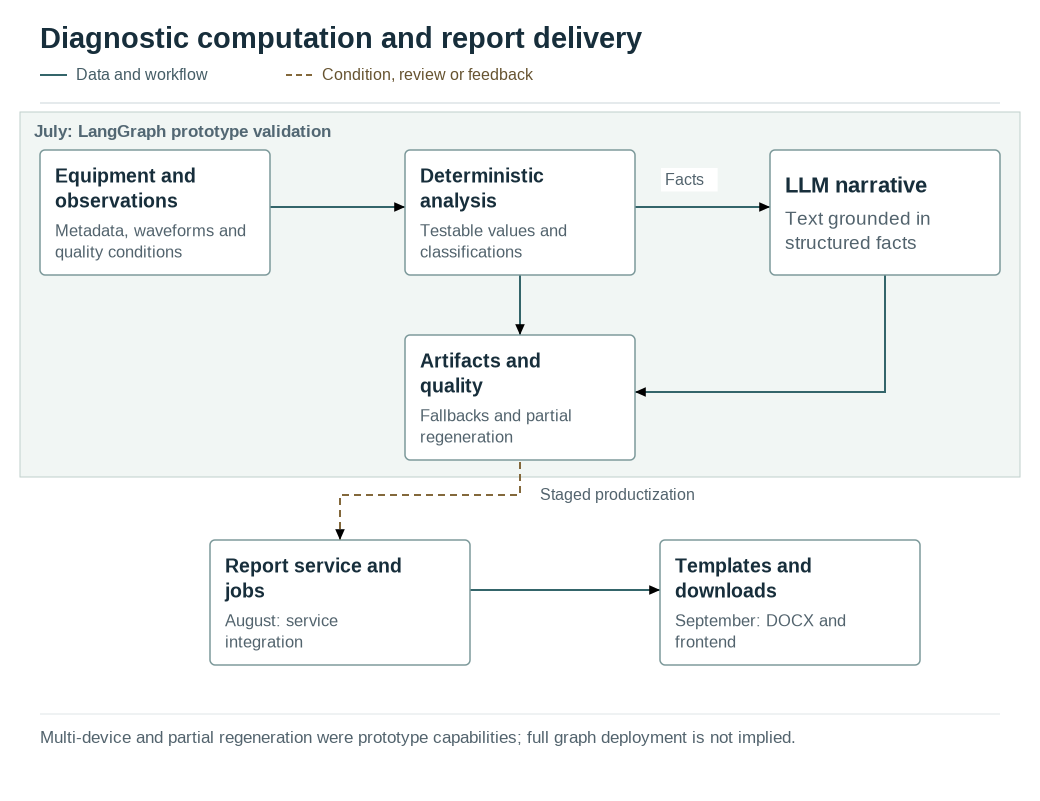
Equipment metadata, observations and diagnostic results.
Process
Testable nodes compute values and classes while the LLM organizes text; nodes retain inputs, outputs and fallback conditions.
Outputs
Report services, platform job dispatch, DOCX and downloads, with intermediate artifacts for tracing conclusions.
Workflow diagram
Multi-device and partial regeneration were prototype capabilities; full graph deployment is not implied. (Enlarge image)
Key design decisions
Separate testable diagnostics from rewritable narrative
ChallengeReports contain classification, severity and lifetime values. Letting a generative model rewrite them together risks losing the numerical basis.
Approach and tradeoffsAnalysis nodes produce verifiable values, which the LLM uses to write explanations. I designed the workflow, node responsibilities, and quality checks, then used a prototype to validate intermediate outputs and insufficient-data handling.
ResultThe July prototype validated multi-device processing, regeneration of selected report sections, numerical determinism and missing-data fallback, leaving reusable methods and quality rules for later services.
Move from one-off reports to platform jobs and downloads
ChallengeGenerating one report does not mean users can select templates, dispatch work and download it from the platform.
Approach and tradeoffsI advanced quality criteria and productization in stages. The team integrated generators, templates and workflows, connecting validated capabilities to services and the platform and later adding DOCX and frontend downloads.
ResultService and platform job integration were completed in August, with DOCX and frontend downloads integrated in September. Complete field orchestration and acceptance still require separate verification.
More technical detail
Retain intermediate outputs and failure handling
The July prototype retained existing analysis scripts and quality rules, turning stable steps into LangGraph nodes. Each device kept its own state; reviewed sections could be regenerated, and insufficient data triggered explicit fallback. Prototype validation is recorded separately from complete field orchestration.
Turn customer observations into testable questions
For field observations about load and vibration, I repeated stratified analysis and delivered explanatory material. Statistical relationships were separated from equipment root causes, with required field checks stated explicitly.
Results and validation scope
Deliverables
Delivered customer analysis reports, built a reusable analysis workflow, and integrated the reporting service. Multi-equipment processing and regeneration of selected report sections were tested in a prototype. The full on-site workflow and formal acceptance remain to be confirmed.
Validation and limits
Multiple devices and regeneration of selected report sections are prototype-validated; platform integration, field deployment and acceptance are tracked separately.
An industrial AI platform for equipment and sensor management, live monitoring and alerts, vibration and partial discharge analysis, remaining useful life (RUL) estimation, diagnostic reporting, and operator feedback.