Turn equipment alarms into traceable partial-discharge analysis jobs, showing both the analytical result and data completeness.
PRPD
WAV
Django
Asynchronous jobs
Role
Contribute to platform dispatch, data semantics and validation design, connecting event windows, waveform data and PRPD services with the team.
Results and status
Completed platform dispatch and service-scenario validation. Current product documentation includes event entry points, results and partial-completion states; end-to-end field operation remains version-specific validation.
Record period
2026 development and validation records
Context and objectives
Turn equipment alarms into traceable partial-discharge analysis jobs, showing both the analytical result and data completeness.
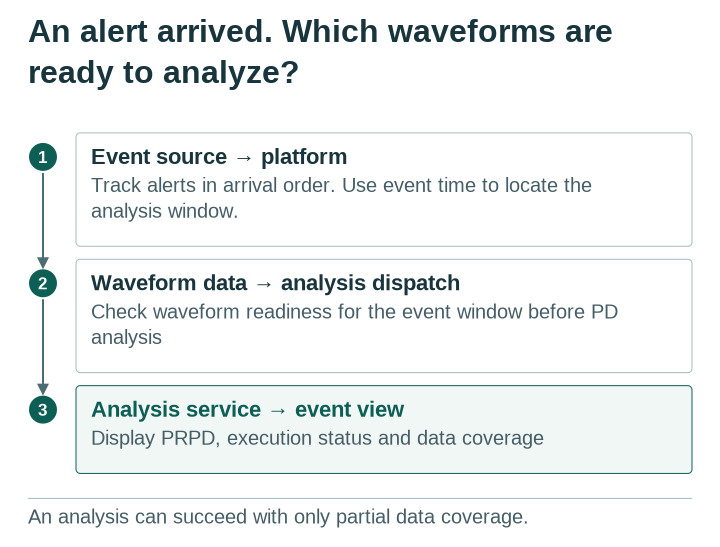
An analysis can succeed with only partial data coverage. (Enlarge image)
System architecture and workflow
Architecture overview
Inputs
Equipment alarm events and event-window waveforms uploaded incrementally.
Process
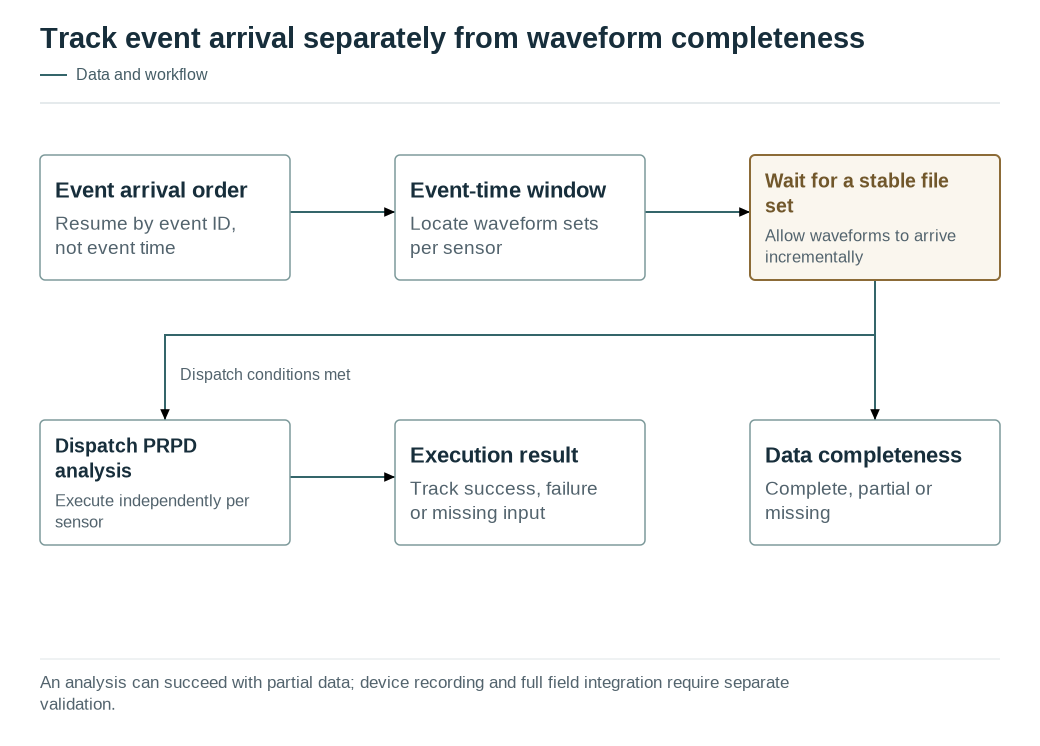
Track new events by arrival order and dispatch after the file set stabilizes. Record execution and completeness separately.
Outputs
Job results express both analysis status and data completeness; success with partial data is a valid outcome.
Workflow diagram
An analysis can succeed with partial data; device recording and full field integration require separate validation. (Enlarge image)
Interface and interaction
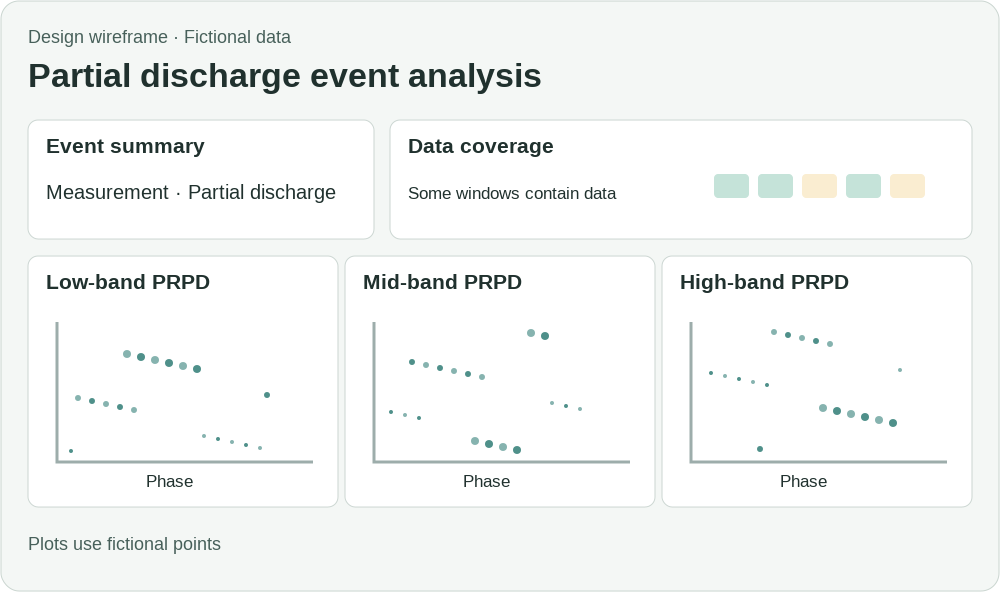
Compare the event summary, data coverage, and three PRPD bands in one view. The plots and states use fictional data.
Design wireframe · Fictional data. The event summary, data coverage, and three PRPD bands share one view so readers can interpret plots in context. (click to enlarge)
1 / 1
Key design decisions
Answer execution success and data completeness separately
ChallengeWaveforms arrive file by file. Existing files do not mean an event is complete; immediate dispatch can present partial analysis as a complete result.
Approach and tradeoffsI contributed domain, dispatch and validation judgments. File-set stability governs dispatch, with execution state and completeness retained separately. The team and agents adjusted waiting behavior using actual arrival delays and allowed success with partial data.
ResultThe platform changes were merged and exercised on complete, partial, missing, overflow and multi-sensor cases. Device-triggered recording and further integration remain prerequisites.
Track backfilled events by arrival order
ChallengeEvents uploaded by an offline device may have old timestamps. Resuming from the latest event time can permanently miss newly arrived records.
Approach and tradeoffsThe team and agents changed resumption to event IDs, using arrival order to discover events and event time to select analysis windows. Each sensor dispatches and terminates independently; checks cover cursors, file-count semantics and statistics.
ResultVerified cursor positions, file counts and statistical semantics in multi-sensor and missing-data cases so late arrivals are not ignored because their event timestamps are older.
Results and validation scope
Deliverables
Completed platform dispatch and service-scenario validation. Current product documentation includes event entry points, results and partial-completion states; end-to-end field operation remains version-specific validation.
Validation and limits
This case retains both historical dispatch tests and frontend states in later product documentation. Demonstration screens do not establish complete data chains or acceptance at all customer sites.
An industrial AI platform for equipment and sensor management, live monitoring and alerts, vibration and partial discharge analysis, remaining useful life (RUL) estimation, diagnostic reporting, and operator feedback.