Connect lifetime analysis to threshold management: validate the model basis, then separate recommendation, adoption and dispatch so users retain control.
RUL
Parameter ablation
SHA-256
API
Gateway threshold OTA
Role
Review data assumptions and parameter ablation; design layered control for model recommendations, platform adoption and Gateway dispatch, integrating and validating with the team.
Results and status
Integrated threshold status and history synchronization, per-sensor policies for automatic adoption or manual settings, and safety limits. Service and regression tests were completed. Lifetime estimates still require calibration and validation against field data.
Record period
2026 development and validation records
Context and objectives
Connect lifetime analysis to threshold management: validate the model basis, then separate recommendation, adoption and dispatch so users retain control.
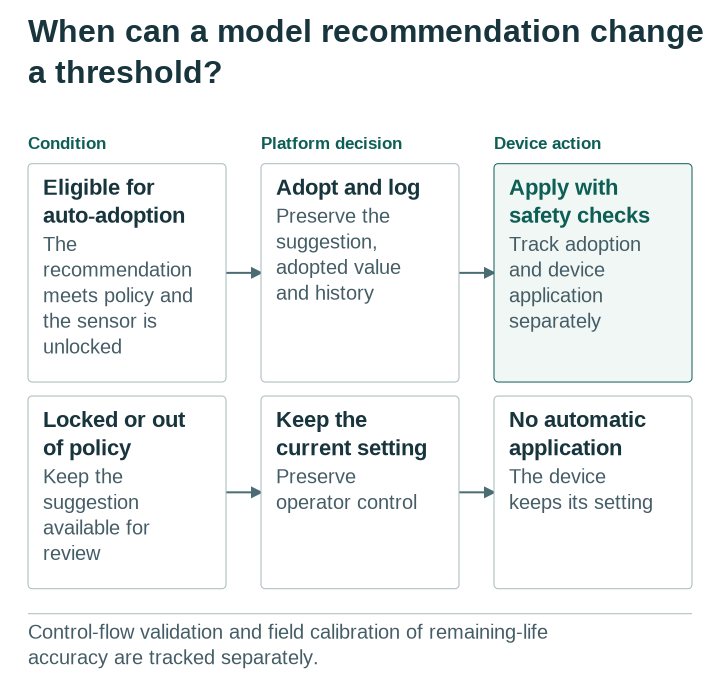
Control-flow validation and field calibration of remaining-life accuracy are tracked separately. (Enlarge image)
System architecture and workflow
Architecture overview
Inputs
Equipment time series and model recommendations for lifetime and thresholds.
Process
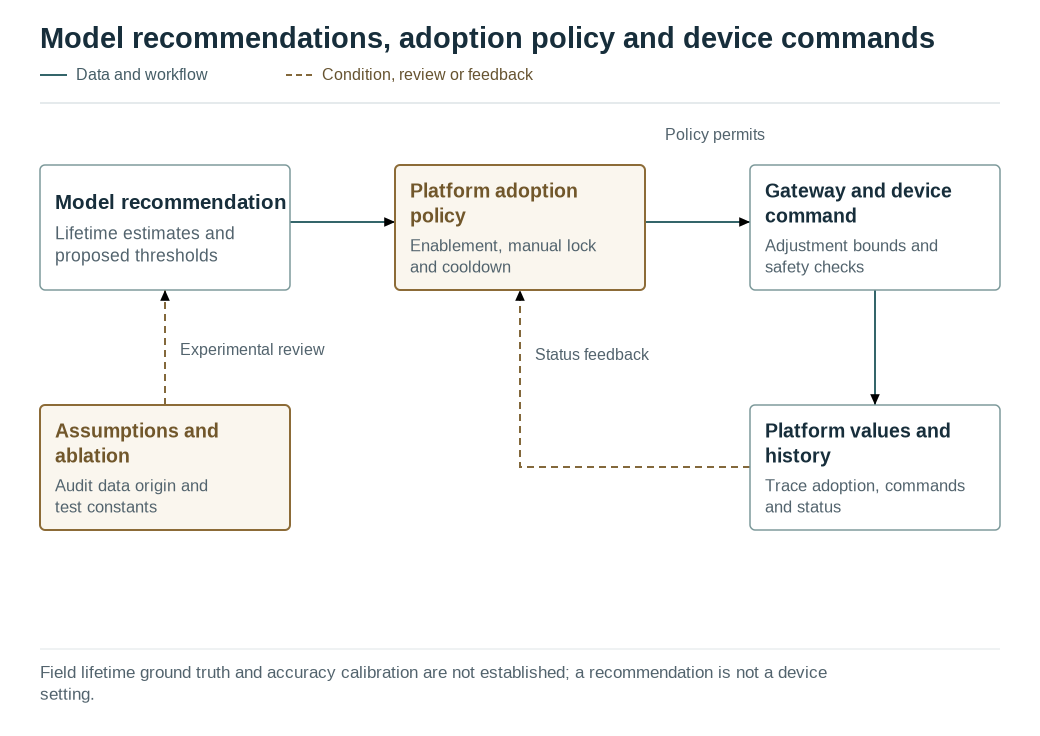
Validate assumptions, then apply sensor policies, manual locks and safety criteria before adoption.
Outputs
Manage device commands, platform values and history separately while retaining user control.
Workflow diagram
Field lifetime ground truth and accuracy calibration are not established; a recommendation is not a device setting. (Enlarge image)
Key design decisions
Withdraw a plausible AI conclusion and audit its evidence
ChallengeAI had recommended a correction, but the cited real data was actually test constants and could not support a product decision.
Approach and tradeoffsI invalidated contaminated values and approvals, then required ablation across parameters and data shapes. I challenged data provenance and causality, comparing degradation and healthy sequences. Research notebooks called implementation functions directly and checked code hashes.
ResultControlled experiments exposed how an existing limit masked rapid deterioration and checked false alarms on healthy sequences, restoring a traceable basis for the correction.
Apply adoption policies before changing equipment thresholds
ChallengeA new recommendation does not mean every sensor threshold should change immediately. Frequent changes make control hard to understand.
Approach and tradeoffsI built a threshold-feedback control layer separating calculation, adoption and dispatch, with manual policy and safety constraints. The platform checks global enablement, sensor policy, manual locks, cooldown and adjustment bounds, synchronizing values and history.
ResultRecommendations, adoption and commands have separate accountability and history, while users retain manual control. Field lifetime ground truth still needs calibration.
Results and validation scope
Deliverables
Integrated threshold status and history synchronization, per-sensor policies for automatic adoption or manual settings, and safety limits. Service and regression tests were completed. Lifetime estimates still require calibration and validation against field data.
Validation and limits
Model comparisons and control-flow validation are complete; field lifetime ground truth and accuracy calibration are not established.
An industrial AI platform for equipment and sensor management, live monitoring and alerts, vibration and partial discharge analysis, remaining useful life (RUL) estimation, diagnostic reporting, and operator feedback.