Test vibration diagnostics and integrated reporting with field data, documenting data limits and adoption conditions.
VAD
ISO 20816
LangGraph
Role
Led validation from equipment metadata and preprocessing through operating detection, classification, severity and RUL, using notebooks to check values and interpretation.
Results and status
Completed field diagnostics and reusable reporting methods, including fallback for low coverage and confidence, supporting later service integration.
Record period
2026 proof-of-concept records
Context and objectives
Coverage, operating state and sampling affect diagnostics, requiring validation of conditions supporting report conclusions.
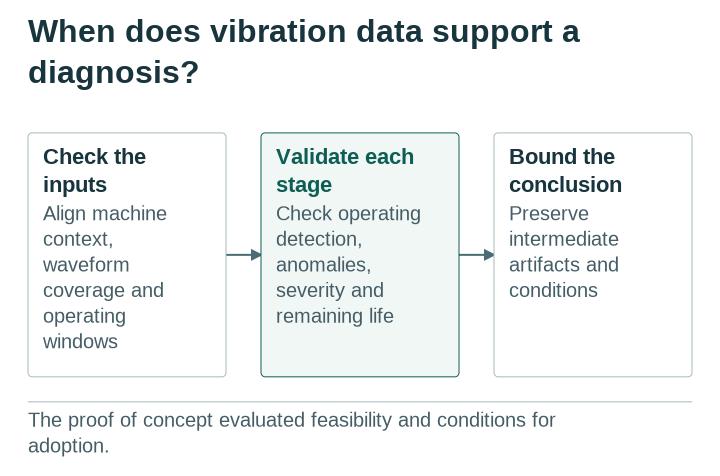
The proof of concept evaluated feasibility and conditions for adoption. (Enlarge image)
System architecture and workflow
Architecture overview
Inputs
Field equipment data, metadata and raw waveforms.
Process
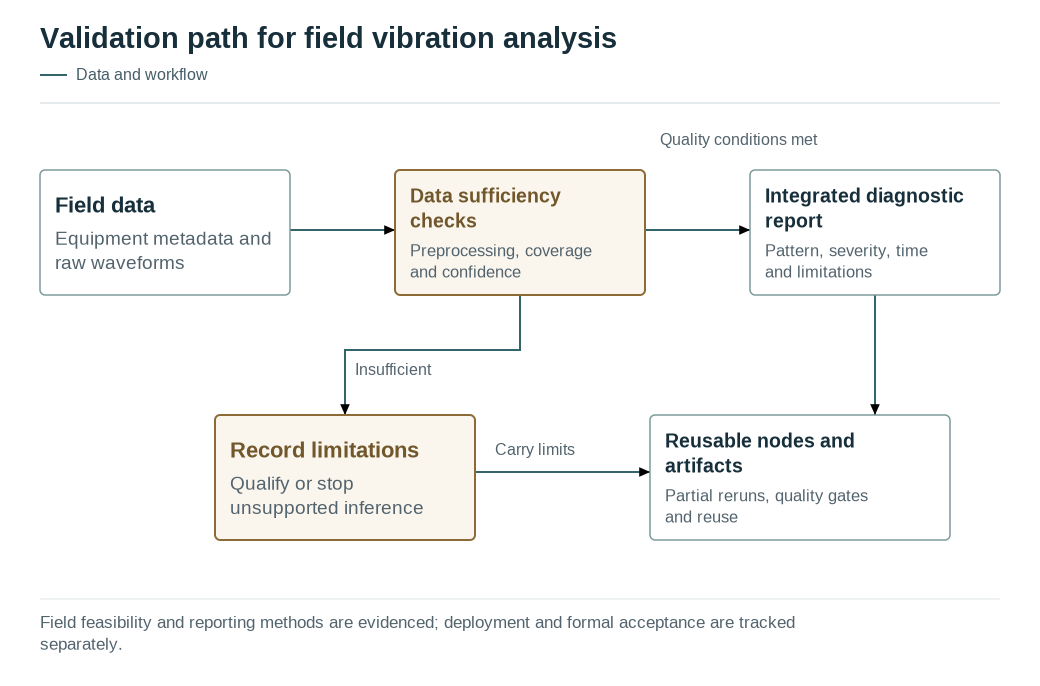
Validate preprocessing, operating detection, classification, severity and lifetime in sequence, checking coverage and confidence.
Outputs
Integrated diagnostic reports and reusable methods with intermediate artifacts and data limitations.
Workflow diagram
Field feasibility and reporting methods are evidenced; deployment and formal acceptance are tracked separately. (Enlarge image)
Key design decisions
Define supported inference before generating a report
ChallengeCoverage and operating proportions vary. Always emitting a class and lifetime would create certainty unsupported by the data.
Approach and tradeoffsI led the diagnostic chain and quality boundaries, making data sufficiency, operating coverage and fit confidence visible fallback conditions. AI agents and skills supported data processing and traceable report artifacts.
ResultBuilt a workflow from equipment and data facts through diagnosis, severity and time, retaining limitations instead of forcing conclusions.
Leave reusable methods after a one-off analysis
ChallengeCustomer analysis spans metadata, preprocessing and multiple diagnostic stages. Ad hoc conversations alone do not support reruns or consistent review.
Approach and tradeoffsValidated quality rules in reusable analytical steps and turned them into a workflow. I led process design and interpretation rules, verifying partial reruns, incomplete-data handling, and intermediate results before integrating the report service.
ResultRetained a path from proof of concept to reusable reporting. Later service integration is documented in the reporting project.
Results and validation scope
Deliverables
Completed field diagnostics and reusable reporting methods, including fallback for low coverage and confidence, supporting later service integration.
Validation and limits
The field study assesses analytical feasibility and adoption conditions; deployment and acceptance are separate work.